Red Dresses Mark What Systems Already Know
Red Dresses Mark What Systems Already Know
Frontline Statement from Centre for Family Equity, Erin Arnold, Surrey Women’s Centre, Victoria Women’s Transition House Society, Prince George Sexual Assault Centre, and Pacific Post Partum Support Society on Violence Against Indigenous Women, girls and Two Spirit on Red Dress Day, May 5, 2026
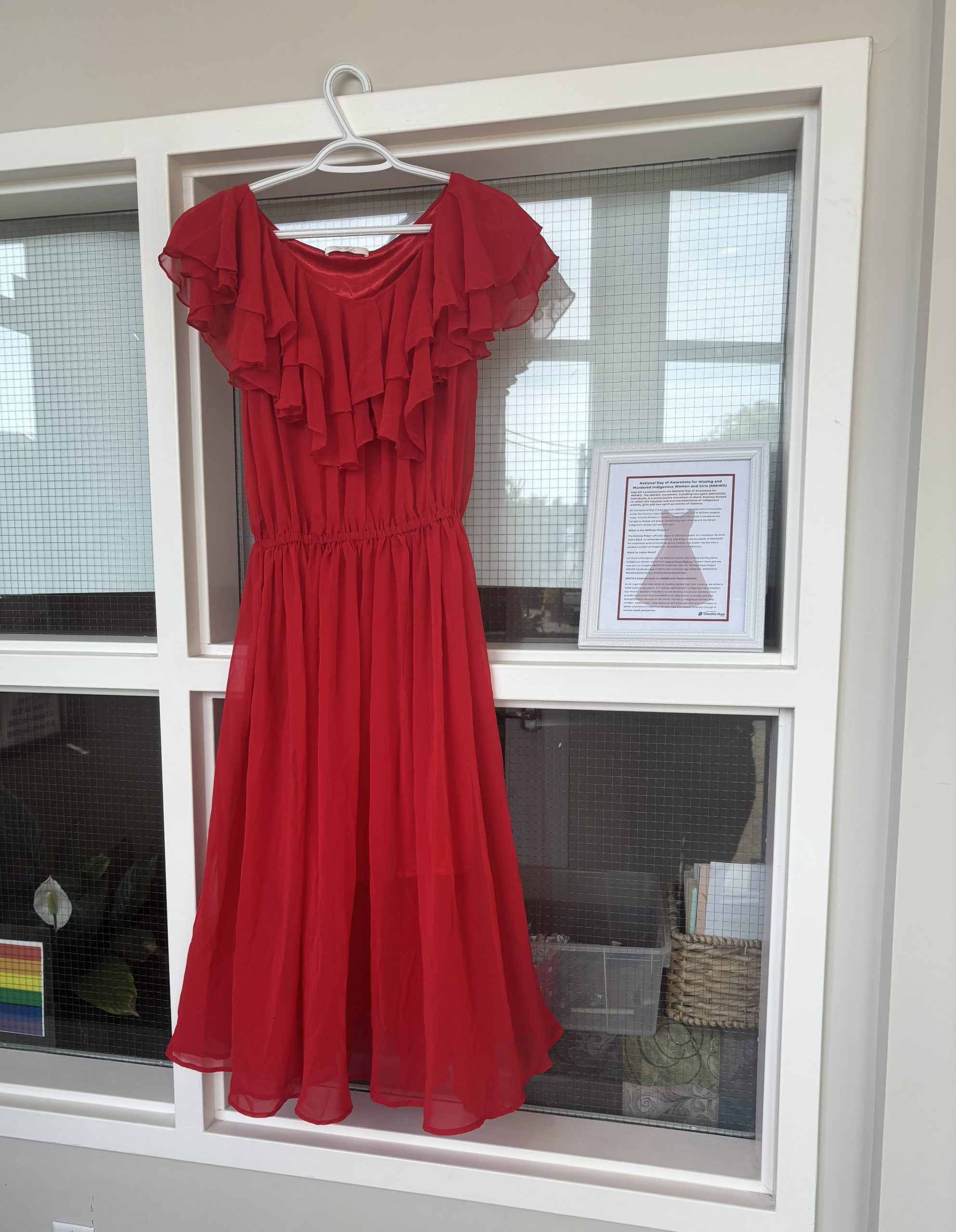
Red dresses are appearing again. Hung along streets, in trees, on fences and building fronts, people pass them every day and families recognize them immediately. Evoking presence by marking their absence.
May 5th is weighted with the lives of Indigenous women and girls who have been taken or left unaccounted for. The REDress Project, created by Métis artist Jaime Black, made visible what Indigenous families, communities, and advocates have long been forced to carry: the ongoing violence against Indigenous women, girls, and Two-Spirit people, the loss endured, and absence that follows.
Noelle O’Soup was a 14-year-old Nēhiyaw girl in government care who went missing from a group home. She was found in a locked room, in a building that had already been flagged to police multiple times.
Chelsea Poorman, a 24-year-old Cree woman from Kawacatoose First Nation, was found in the yard of a vacant mansion in Vancouver, and her death was closed within days despite critical gaps in the investigation.
Tatyanna Harrison, a 20-year-old Métis woman, had been reaching out for help in the weeks before her disappearance, moving between hospitals, housing, and crisis services, and was not identified for over a month after her body was found.
Their lives show how Indigenous women and girls move through systems that are already in contact with them. Where risk is known, documented, and still not acted on in ways that would have changed the outcome. Advocacy led by Indigenous women, including long-standing leadership from Justice for Girls, has consistently named these patterns and demanded accountability, yet the same conditions continue to produce the same outcomes.
Families in Surrey and across the Fraser region continue to search for loved ones who have not come home. Some were last seen moving between Surrey, Langley, and Vancouver. Their cases are not held in one place, and neither is accountability. The absence of a single, coordinated record reflects the same fragmentation that shapes the response to their disappearances.
Indigenous women are killed, go missing, and experience violence at rates far beyond others in this land now known as Canada. That reality is not new information It has been documented repeatedly by families, community organizations, and through national processes including the National Inquiry into Missing and Murdered Indigenous Women and Girls. The 32 Calls for Justice named what is required.
The gap between what has been named and what has been implemented remains.
Across British Columbia, the same patterns continue. Indigenous women who are killed are often already known to systems. There have been reports, prior violence, escalating risk, and multiple points of contact with police, courts, and service providers. A recent review by the BC Coroners Service confirmed that these deaths follow a pattern. What changes is not the violence, but the failure to act on what is already known.
Colonial violence shapes these outcomes in concrete ways. Displacement from land and community, child welfare involvement, over-policing alongside under-protection, and systemic racism across institutions all narrow the conditions for safety. Indigenous women navigating violence are often doing so within systems that have already caused harm, and that continue to respond unevenly when protection is sought.
The broader conditions across this province are tightening. Housing is increasingly inaccessible, making it more difficult to leave violence safely. Economic pressure extends exposure to harm. Services remain under-resourced relative to demand. At the same time, anti-Indigenous racism continues to shape how violence is perceived, minimized, or dismissed.
From the frontline, these are not abstract dynamics. Our organizations work directly with Indigenous women navigating violence every day. Women are managing immediate safety concerns alongside the long-term impacts of systemic and interpersonal violence, often while caring for children or elders and navigating multiple systems at once.
Indigenous women are not overrepresented in these patterns by coincidence. The conditions that produce this level of risk have been built over time and are sustained through policy, funding decisions, and institutional practice. The same systems that document risk do not consistently act to reduce it.
Work at the frontline makes clear what is required: risk must be recognized and acted on consistently across systems. Indigenous-led responses must be resourced and supported at a scale that reflects the reality of the violence. Safe and accessible housing must be available when women seek to leave. Public safety must account for the violence occurring within homes and relationships, not only what is visible in public space. Accountability must follow the patterns that have already been documented.
Red dresses continue to move across this province, and they do not represent isolated loss. Each one marks an Indigenous woman, girl, or gender-diverse person within a pattern that has been named, studied, and left to continue.
The conditions that sustain that pattern are still in place, until they are changed, the dresses will remain.
Show your support at an event near you:
Vancouver
BWSS will host a gathering at 9:15 am Victoria Park, Vancouver
Surrey
Red Dress Day: Lunch and Learn at SFU Surrey Campus or on Zoom. Register through Eventbrite.
New Westminster
Ceremony at Hyack Square, 1pm to 3pm.
Maple Ridge
Gathering at Maple Ridge Secondary Track, 9am to 5pm.
Pitt Meadows
Ceremony at šxʷhék̓ʷnəs (Spirit Square), 11985 Harris Rd at 1pm.
Victoria
Karla Point Hii nulth tsa kaa is hosting a gathering at UVic’s Faculty of Fine Arts, 12:30pm to 1:30pm.
Duncan
10k walk/run “Gone but not forgotten” at Si’em Lelum Gym, 5574 River Rd at 9am.
Vernon
Gathering and walk hosted by North Okanagan Friendship Centre at 2904 29th Avenue, 11am.
Fort St. John
Market, walk and candlelight vigil at Festival Plaza in Centennial Park, hosted by the Fort St. John Friendship Centre and Métis Society.
Kamloops
Gathering at Moccasin Square Garden, 357 Chief Alex Thomas Way, Tk̓emlúps te Secwépemc, 10am to 2pm.
Read past statements:
2023 and 2025
For more information:
Alexandra Kilian, Surrey Women’s Centre – Email: alexandra@surreywomenscentre.ca
Angela Marie MacDougall, BWSS – Mobile 604-808-0507